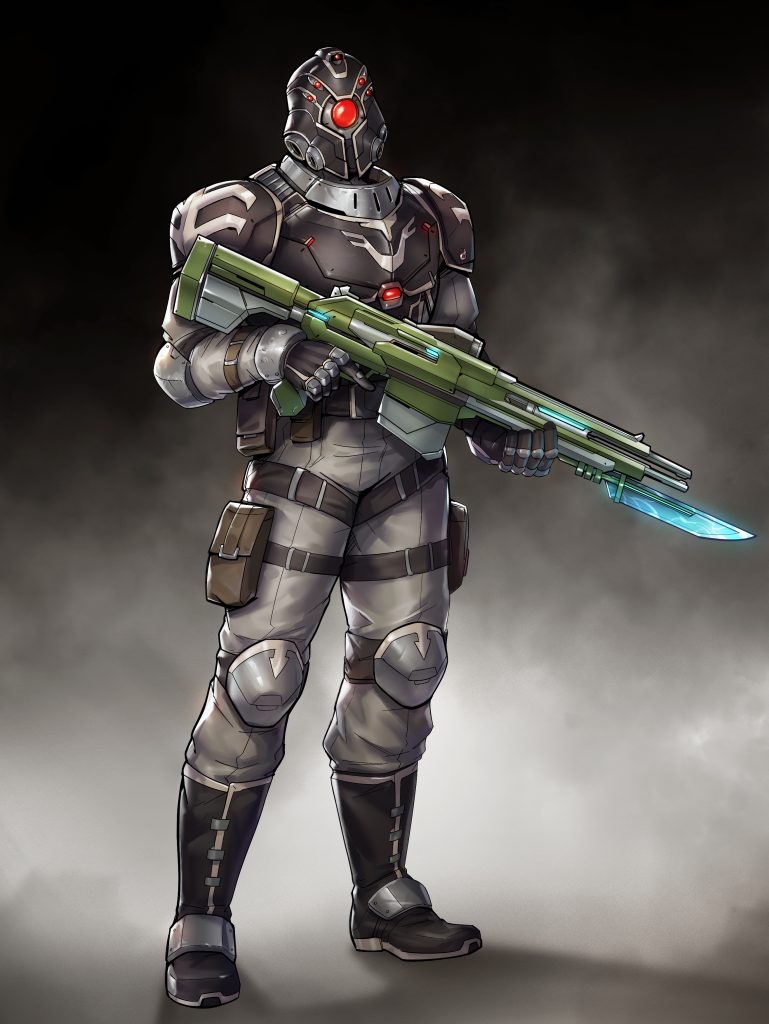
Combat armor
The standard protective gear for a soldier. It comes with xanthium plating over the vitals of the soldier and heavy cloth protecting the rest. While this plating can stop bullets from gunpowder weapons, only at long-ranges can it stop mag-rifle rounds. Though that is not its main purpose. The armor still provides good protection from shrapnel and debris.
The helmet of the gear comes equipped with a full communication suite, along with infrared and night vision capabilities. Gas filtration within the helmet enables the wearer to operate in smoky environments unimpeded. Other dangerous elements in the air can also be filtered for up to one hour.
The humble mag-rifle
The most ubiquitous weapon of any modern army. The mag-rifle ranks head and shoulders above old gunpowder weaponry in both power and versatility. The common rifle round used by both Ostrus and Ashua is 9.2mm in diameter, and on max power settings, the rifle can produce a muzzle velocity of slightly over 5000ft/s. This gives the mag-weapon the ability to effectively engage targets at long ranges, and to kill large alien beasts.
However, the power setting of the rifle can also be lowered to subsonic speeds, making the firing of the weapon produce little noise, perfect for stealth operations.
Mag-rifles can also be equipped with a frequency bayonet. The powerpack on the weapon vibrates the xanthium bayonet at such a high frequency that it can cut through almost anything, including carapace power armor.
The common magazine for a mag-rifle holds sixty rounds, despite not being much larger than magazines of old. Much of the size of old gunpowder bullets was the propellant, something that is not required for magnetic weaponry. This allows the rounds themselves to be bigger, allowing for different variants of shells from armor-piercing sabot, firestarter, and explosive rounds. The magazine will also come with a powercell to power the weapon for firing. Though a single charge can power a mag-rifle for up to 80 full-charged shots. This is due to the recoil absorption mechanism in the weapon. Once fired, the recoil of the shot moves back the heavy feeding mechanism, not only lowering the kick of the weapon for the user, but also generating power for the weapon, the action spinning a generator within the rifle.
While indeed powerful for its weight class, the mag-rifle pales in comparison to almost any other weapon.
The mag-60
The premier heavy machine caliber, it shoots a 15.2mm 2500 grain projectile at over six times the speed of sound. Only fortified positions and heavy armor can stop such a round. It can go through entire houses and its trajectory and speed are barely affected. The standard mag-60 round comes equipped with a fused explosive warhead, meant to explode after penetrating an armored target. This is to turn the crew of carapace armor and light vehicles into shredded meat upon breach of their armored shells. The warhead also functions nicely to drop lyshan crystal mutated creatures as well.
While a human in combat gear is far too squishy for the warhead to fuse, the power of the round itself is more than enough to cleave a man in two.
Corona Gun
The most powerful weapon a normal soldier can carry. The weapon can either fire plasma in concentrated bolts, perfect for boiling through armor, or in a flamethrower variant, easily melting dozens at once. The decaying magnetic field around the bolts limits the effective range of the corona weapon to far less than their mag-weapon counterparts. However, one can melt through even a tank’s armor with one equipped.
The usage of this armament requires a soldier to carry a powerpack on their back. This pack will react violently if the containment chamber is breached, bathing the user and anyone around them in boiling plasma. The only reprieve is that their deaths will at least be quick. But the firing of the weapon is stable, if there is no damage to the weapon itself.
The main use of corona weaponry is to destroy vehicles and for siegebreaking. A single corona-gun can empty out an entire building, the plasma melting through walls and setting fire to everything flammable. Because of this capability, corona-guns are especially popular for lyshan crystal mining operations. A team can burn away swathes of hostile flora and fauna efficiently.
Despite the danger of operating a corona-gun, the weapons still remain incredibly popular. They give the common soldier the ability to fight almost anything, provided the conditions are right.
Arm mounted Warden system(ARM-WAR)
A massively scaled down version of the hard energy shield system used on heavy vehicles and starships. An ARM-WAR once again requires a powerpack to use, plus servo assistance for the user to properly lift the projector attached to the arm. But the protection provided more than makes up for it. Once activated, the ARM-WAR projects a rectangular block of hard energy that stands tall enough to cover the entire soldier. The system can stand up to two mag-60 rounds before the energy completely shatters. Against normal mag-rifles, the ARM-WAR can block those projectiles almost indefinitely.
A popular addition with the ARM-WAR is an arm mounted version of the mag-rifle. This attachment is also servo-assisted to carry the weight and to stabilize the recoil. A connection cable is plugged into the weapon to the user’s helmet to show where the barrel is aimed.
ARM-WAR users will take to the front in squad tactics. They provide mobile cover while running to new positions, and to protect heavy weapons teams.
Hardkill launcher
While the invention of xanthium and vehicle-level energy shields has left the tank protected beyond what an infantryman could carry, besides corona weaponry, the RPG still has a place on the battlefield.
They are now used to destroy carapace-armor users, fortified positions, and lighter vehicles. Advances in rocket propulsion and explosives has also shrunk the rocket below the size of the pre-Expansion Age counterparts.
The launcher itself is rather simple. It’s a shoulder-carried tube, with a sight and laser. A feeding mechanism on the top enables single-loading of a rocket, or a magazine of three. The magazine can be fired in quick succession, allowing a user to pop up and devastate an area before returning to cover.
Hardkill rockets come in two main variants: HE(high explosive), and HEAV(high explosive anti vehicle). The user can use the laser on the launcher to find the accurate range of a target and program the rocket to detonate at the designated range, airbursting above cover. On guided variants of hardkill rockets, the laser will direct the missile towards where the laser is pointing, allowing for pinpoint long range strikes. Though these variants are far more rare.
Javelin Breacher
The ultimate weapon in cover denial systems. The launcher magnetically fires a large spike towards a target at just above the speed of sound. Upon getting close to the barrier, four cutting fins will extend outwards, from the information given to it by the laser-designator on the launcher. The purpose of the fins is to arrest the movement of the spike. To assist with this, the fins will have multiple exploding bolts that shoot wires into the superstructure of what the javelin hits. This feature is used for softer targets, where the energy of the spike would carry it through a wall instead of simply embedding itself. Upon lodging itself within a wall or object, the second stage of the javelin will activate. A second spike within the larger one will be propelled forwards at high speeds by an explosive within. The secondary stage will then hopefully go through whatever cover is left. Upon leaving three feet from the mouth of the initial spike, the javelin will explode into a deadly shower of shrapnel.
Anything that isn’t at least protected by carapace power armor will be instantly turned into ground meat. Even those in carapace suits, if they are right next to the detonation will find their armor turned asunder. Javelins have found their home in urban warfare and sieges.
They can simultaneously penetrate into bunker complexes and lodge into the thin walls of civilian buildings. A single shot is more than enough to completely clear out a room. Javelins are also highly effective against light vehicles, being able to go through their armor and then slaughtering the crew inside.